Chapter one / Origins

Many ways
to kick a ball

Football was not invented once. It was reinvented repeatedly. Before the English wrote a rule book, at least five civilisations had independently built games around driving a ball with the body — with incompatible rules, materials and meanings, and one thing in common: divide people into two sides, give them one moving object, and let them fight for it.

Span 3000 BCE — 1863 Coverage Mesoamerica · China · Greece · Rome · Italy · England Question why only one line became modern football
3000 BCE

Mesoamerica: rubber, rings and the risk of death

ULAMA · MESOAMERICA

The earliest known team ball game belongs to the Olmec world of the Gulf Coast. Roughly three thousand years ago, people there made solid balls from natural rubber — the first bouncing ball in history, and the precondition for the whole sport. Europeans would not regain that material capability, through vulcanisation, until the nineteenth century.

The court was a narrow I-shaped alley of stone, flanked by sloping walls; Maya and Aztec versions embedded vertical stone rings into them. Players struck the ball with hips, thighs and upper arms, and were forbidden to touch it with hands or feet — an exact inversion of the modern game, where everything but the arm is legal. The great court at Chichén Itzá runs about 96 metres, with rings set some 8 metres above the floor: scoring through them was roughly the equivalent of posting a coin through a standing ring from the length of the pitch.

It was never only a game. Matches were tied to creation myths, the movement of the sun and political alliance, and the outcome could mean sacrifice. This is the version of football furthest from pure entertainment — and a reminder that putting a ball through a target has rarely been just about the ball.

END ZONECENTRE LINEEND ZONE Stone rings, set vertically in the walls, about 8 m up Ball struck with hips — hands and feet forbidden
Fig. 1-1Simplified plan of a Mesoamerican ballcourt after the great court at Chichén Itzá. The I-shaped alley is flanked by sloping walls with the rings set mid-wall.
3rd c. BCE

China: from drill to professional club

CUJU · 蹴鞠

Cuju is recorded before the Han dynasty, but the Han institutionalised it as military training. The Book of Han lists the twenty-five chapters of cuju under military texts — not an entertainment manual but a drill book: chasing, passing and contesting in a confined space, training coordination and stamina.

Two technical changes arrived in the Tang dynasty. First, the inflated ball — an animal bladder inside a sewn leather skin — replaced the solid hair-stuffed ball, making it lighter and bouncier, capable of being lofted and controlled in the air. Second, two formats appeared: goals at each end, or a single goal on a tall pole at the centre of the pitch, with both teams attacking it.

Under the Song, the game commercialised. Cities had professional clubs such as the Qi Yun Society, with membership rules, grading, and exhibition freestyle (the "bai da" repertoire). The Water Margin's villain Gao Qiu rises to power on the strength of his ball control.

Yet cuju never became the modern form: two teams, two goals, decided on goals scored. Two explanations are usually offered — it never fully left the frame of display and ceremony, and it never built a cross-regional rule book or competition structure. From the Ming and Qing it declined into folk game and acrobatics.
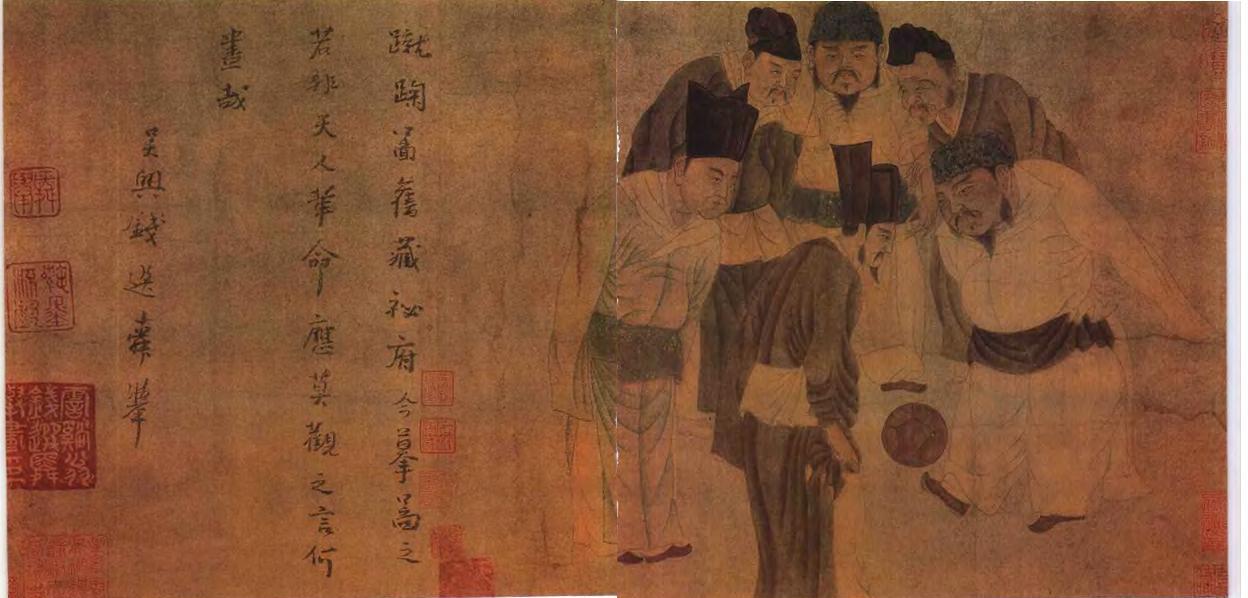
Song-dynasty painting showing Emperor Taizu and his ministers playing cuju
Fig. 1-2Emperor Taizu Playing Cuju, attributed to Qian Xuan (Yuan-dynasty copy). The Song founder Zhao Kuangyin plays with his ministers — direct pictorial evidence that cuju had entered court life. — Public domain, Wikimedia Commons
A claim usually overstated

"Football was invented in China" is widely repeated, but strictly cuju has no institutional descent into modern football: no continuous rule text, no organisational lineage, no competitive record. It is a parallel branch, older by two millennia. "A distant cousin" is more accurate than "the ancestor".
5th c. BCE

Greece and Rome: two names for team ball

EPISKYROS · HARPASTUM

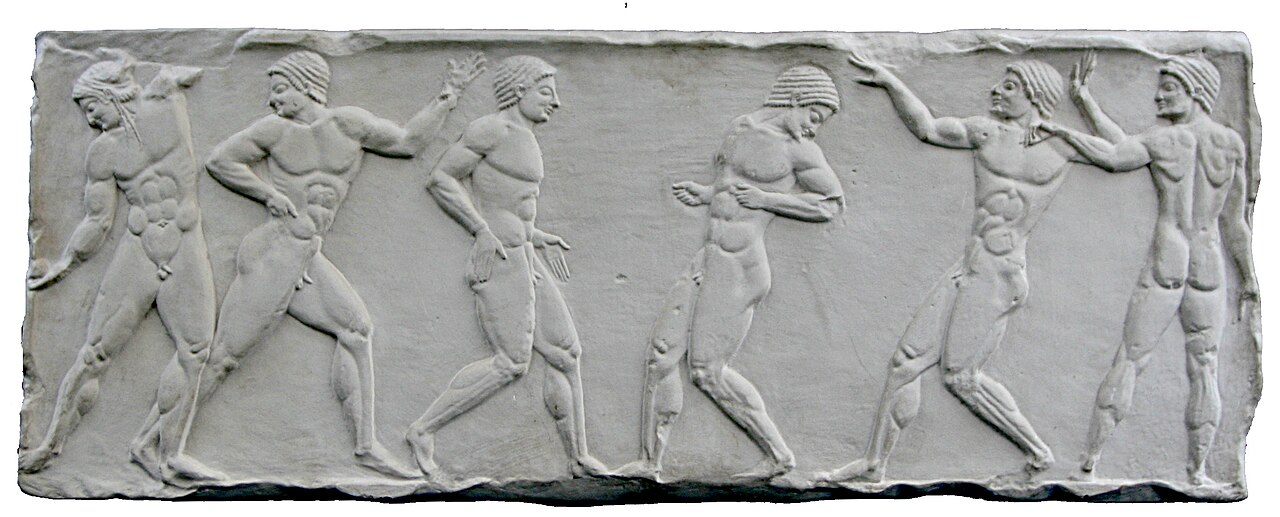
The Greek episkyros appears in fifth-century BCE sources. Playwrights and later grammarians describe two equal teams facing each other across a centre line; the object was to throw the ball over the opponents' back line. Hands were allowed and contact was heavy. The Spartan variant, sphairomachia, was rougher still.

Rome inherited and adapted it as harpastum — from the Greek for "snatched away". The ball was smaller and harder, often played indoors or on sand; Galen recommended it as exercise. Historians generally place harpastum closer to rugby than to football: the handling, the tackling and the sheer density of contact all point that way.

These two names are often used to claim a Greco-Roman ancestry for football. The more careful claim is that they show team ball games were normal, not exceptional, in the Mediterranean world — while no rule text or organisation survives into the nineteenth century.

Fifth-century BCE Greek marble relief of six athletes playing with a ball
Fig. 1-3Fifth-century BCE Greek relief fragment, usually captioned "ancient Greek footballers", held in the National Archaeological Museum, Athens. The poses show the ball being controlled with thigh and hand. — MatthiasKabel / CC BY 2.5
1580

Florence: a riot with a rule book

CALCIO STORICO FIORENTINO

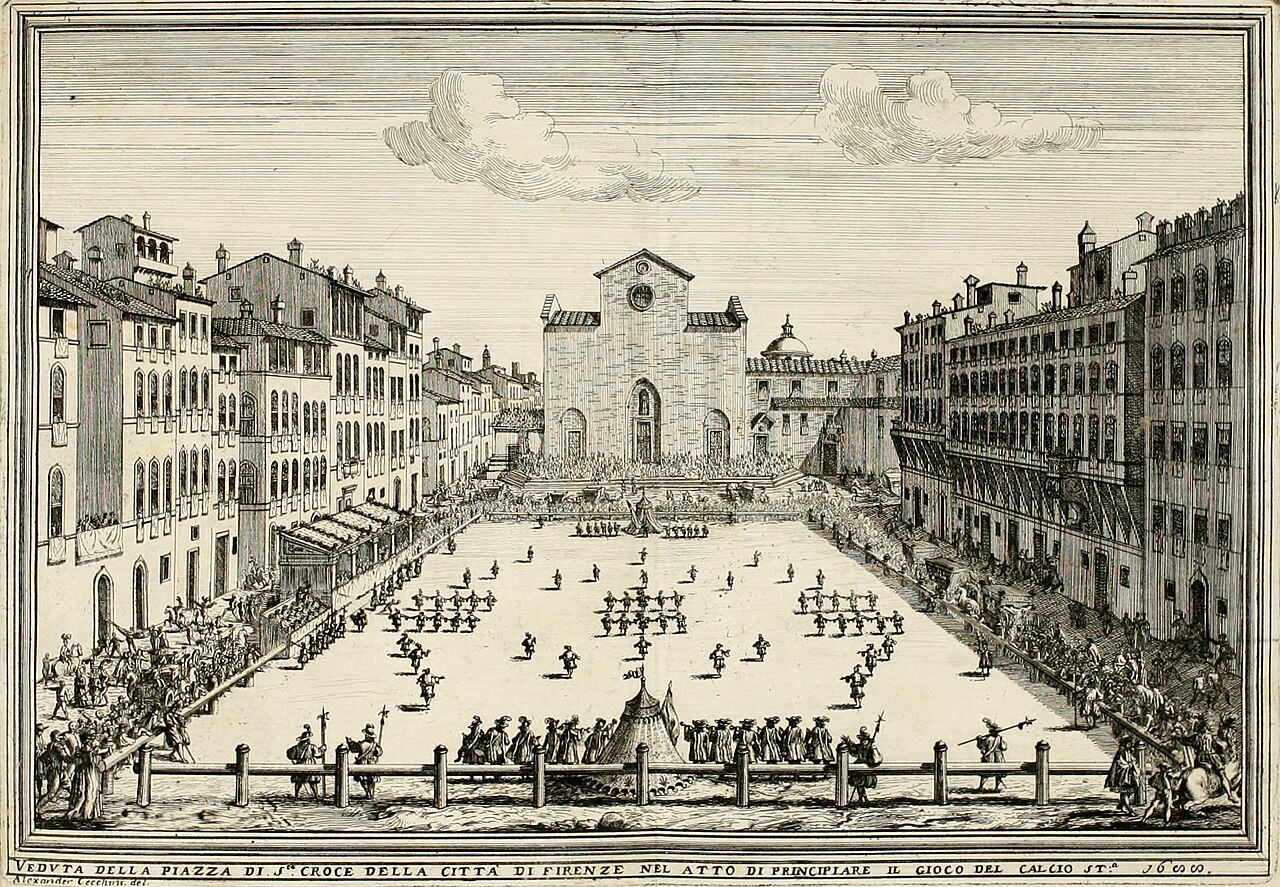
Sixteenth-century Florence played a game called calcio — from calciare, to kick; Italians still call football calcio — in the Piazza Santa Croce. In 1580 Giovanni de' Bardi wrote down its rules in the Discorso sopra il giuoco del calcio fiorentino.

The detail is precise: twenty-seven players a side, of whom fifteen forwards, five midfielders, four defenders and three goalkeepers. The pitch was sanded, with nets some fifteen metres wide at each end. The ball could be handled, kicked or headed; grappling, shoving and punching were all legal. This was a brawl with a rule book. Matches lasted fifty minutes and a goal was celebrated with cannon fire.

Its importance is methodological rather than genealogical: it is one of Europe's earliest attempts to write a folk game into a text. When the English attempted the same in the nineteenth century they met exactly Bardi's problem — different places played different games, and nobody wanted to change theirs.

1688 engraving of a calcio fiorentino match in Piazza Santa Croce, crowds packed around the square
Fig. 1-4Engraving of 1688: calcio fiorentino in Piazza Santa Croce. Spectators watch from scaffolding against the façades; the pitch is sanded, with a net at each end. — Public domain, Wikimedia Commons
1300—1800

England: football without rules

MOB FOOTBALL · SHROVETIDE

Medieval England played "mob football" at Shrovetide: a whole town divided into two sides, chasing a ball towards a target that might be a tree, a church door, or the neighbouring village. There were almost no rules — the only shared understanding was that the ball could not be carried. Matches ran for hours, involved hundreds of people, and used a street, a field, or a river as the pitch.

It was dangerous enough to legislate against. Edward III banned it in 1349 on the grounds that it interfered with archery practice; similar prohibitions recur for the next two centuries without ever eradicating it. One ironic consequence: the more often it was banned, the more clearly it was popular.

The real turning point came in the nineteenth-century public schools. Eton, Harrow, Winchester and Rugby each evolved their own handling and kicking conventions, and their alumni could not agree on a game. That is precisely what the 1863 meeting was convened to settle. Between "no rules" and "too many rules", modern football found a copyable middle.

Comparison

Five balls,
five world views

Watch the third and fifth columns. The size of the ball and whether hands are allowed determined almost everything else about each game — including how it felt to watch, and how violent it was.
GameDate · placeBallPlayers · pitchHands / feetScoringToday
Ulama3000 BCE · MesoamericaSolid rubber, 1–4 kg2–7 a side · I-shaped stone courtNeither (hips only)Through the ring / past the end lineFolk games survive in Sinaloa
Cuju3rd c. BCE · ChinaHair-stuffed → inflated leatherTwo goals, or one central goalBoth (feet dominant by the Song)Into the goal / through the single netPerformance only; no sporting lineage
Episkyros5th c. BCE · GreeceLeather, medium size12–14 a side · no fixed dimensionsHands primary, kicking secondaryBall over the opponents' lineExtinct
Harpastum2nd c. BCE · RomeSmall, hard leatherVariable · indoor or sandHands, with tacklingCarry or force the ball over a lineExtinct
Calcio storico1580 · FlorenceInflated leather27 a side · sanded square, two netsAll, including punching and grapplingBall into the net; 50 minutesPlayed every June

Note: this table includes only games with clear documentary or pictorial evidence, and excludes local kicking games such as Japanese kemari or Korean chukguk. Player numbers and rules vary between sources; the mainstream version is given here.

“What made modern football distinctive was not kicking a ball. It was making the question of who writes the rules — and for whom — into something negotiable.” Chapter one, in summary